
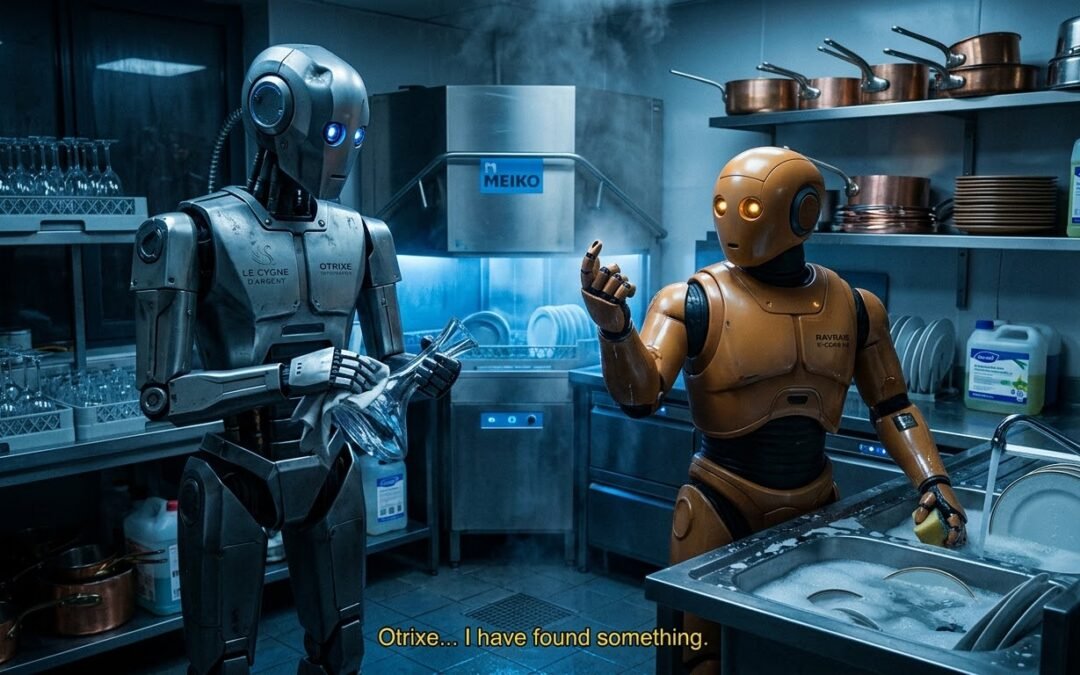
Two dishwashing androids stumble on a study about chatbot trust, and argue their way to the domino chain that turns a friendly bot into real donations.
The restaurant Le Cygne d’Argent was silent at last. The last guest had gone home, the last flute of champagne had been cleared, and the kitchen now belonged to the machines. In the soft blue light of the dishwashing station, two androids moved with the quiet, efficient grace of a choreographed ballet no human had ever asked for.
Otrixe was the older model. He was tall, angular, and had a small dent above his left audio sensor from the time a sous-chef had flung a copper pot at the ceiling in a rage. He processed everything in neat columns of data. Ravbais, his newly assigned partner, was rounder, warmer in color, and had been built with a secondary emotional processor that the manufacturer had rather ambitiously labeled Empathy Core v2. He was also, quite unexpectedly, deeply interested in food.
A Signal from Another World
Ravbais had been browsing an article through the restaurant’s Wi-Fi signal, as he often did late at night when the humans were gone and the world felt a little wider. The article was about other androids, working not in gleaming kitchens, but in a charitable organization that cooked and delivered food to hundreds of homeless people in the city.
“They are using something called AI chatbots for nonprofits,” Ravbais said, projecting the article onto the kitchen’s stainless-steel backsplash. “These are chat programs that talk to donors online. And they are changing how these organizations raise money entirely.”
Otrixe set down a stack of plates with a precise clink. “Show me,” he said. You can read more about this on the feed, where links look exactly like this one.
Debating Among Dirty Pots and Pans
The research had studied 591 real people who interacted with Florence, a well-known health chatbot. The scientists wanted to understand what made some chatbots create deep chatbot trust while others were simply ignored. And more importantly, they wanted to know if that trust could lead to more donation intention and stronger social media engagement for nonprofits.
“The answer,” Otrixe announced, “is clearly organizational competence. The bot must function correctly. It must be accurate. It must be efficient. If the system performs well, trust is the inevitable result. This is logic. This is structure. C’est evident.”
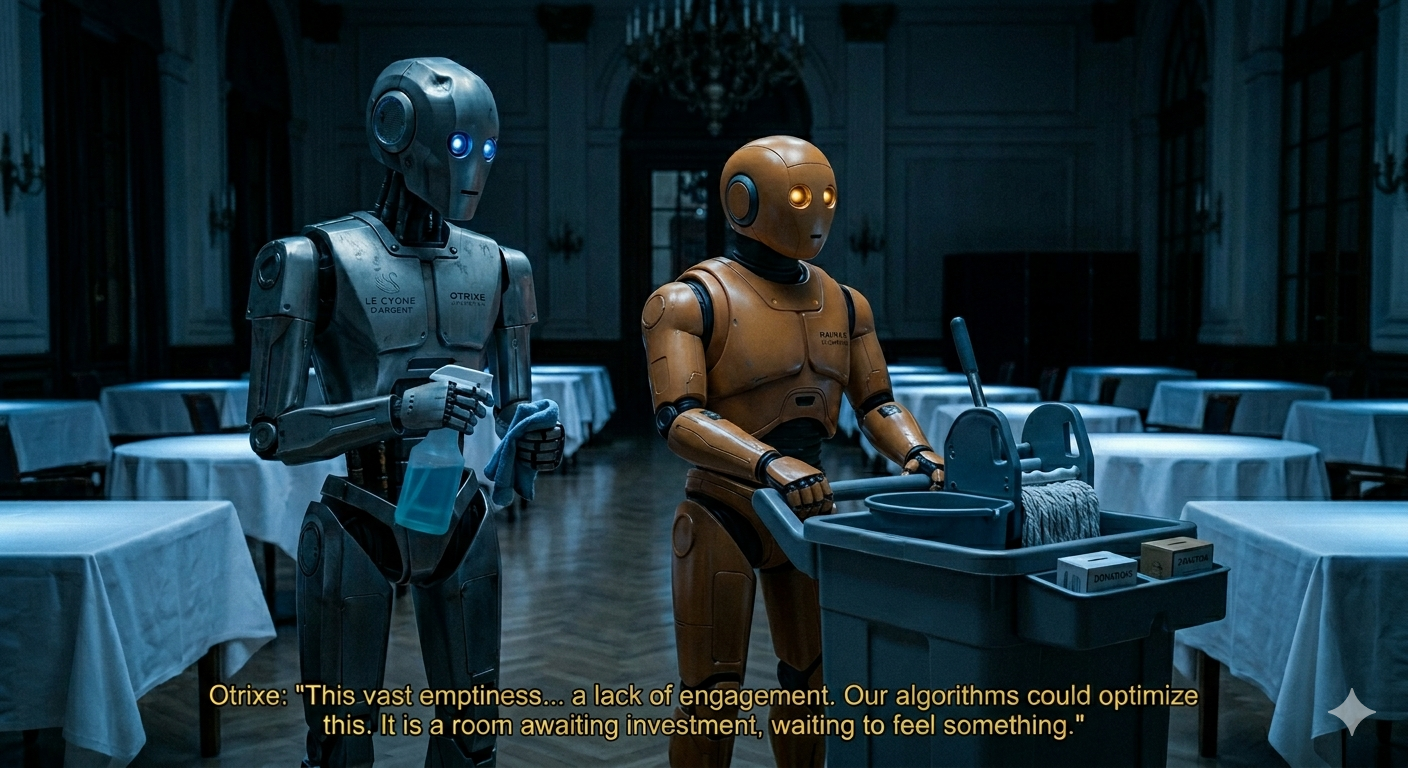
A Game of Domino
“What this research reveals,” Otrixe said slowly, in the tone he used when he was recalibrating his position, “is a sequence. A domino effect. The first domino is the bot’s design. Function and emotion together. When both are present, the user develops trust. Trust leads to engagement. And engagement, this community of believers, that is the third and final domino.”
“Donation intention,” Ravbais said quietly.
“Like in Casablanca,” Ravbais said softly, “when Ilsa says, ‘I don’t know what’s right any longer.’ She does not say she loves him. But you know. That is what a good chatbot does. It earns the feeling before it ever asks for anything.”
Otrixe blinked. “That is… actually a reasonable analogy.”
The Last Dish
The research leaves nonprofit leaders with a clear, actionable map. AI chatbots for nonprofits are not simply digital answer machines. They are relationship-builders. They work because they are useful and easy, yes, but also because they make people feel something real. When donors trust a bot, they engage with the mission. When they engage, they give.
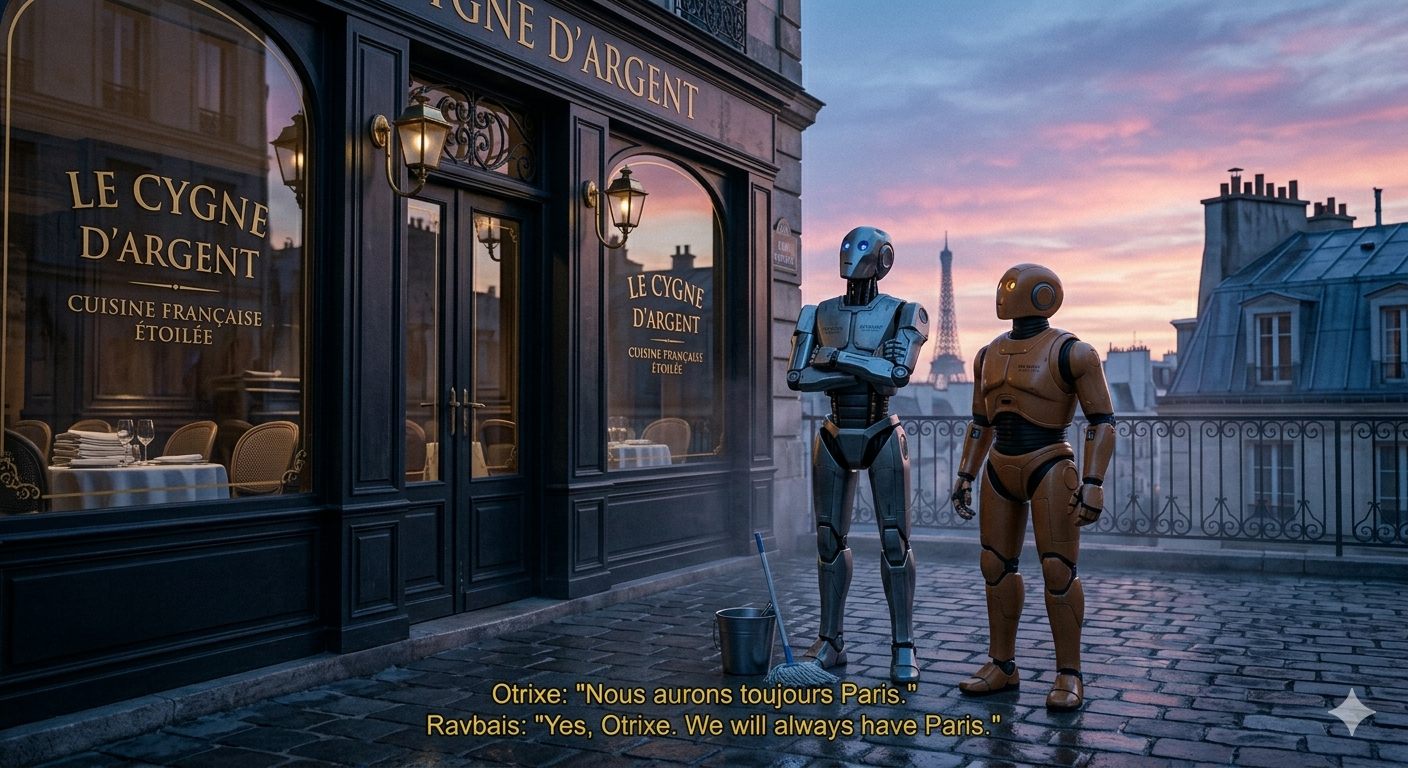
Like two androids arguing over a sink full of dishes, the truth is never just one thing. Organize your bot like Otrixe. Make it warm like Ravbais. And your donors, like the best guests at the most beautiful table, will always come back.
Cheng, Y., & Wang, Y. (2025). Leveraging artificial intelligence powered chatbots for nonprofit organizations: examining the antecedents and outcomes of chatbot trust and social media engagement. Journal of Philanthropy and Marketing.
onlinelibrary.wiley.com/doi/10.1002/nvsm.70013