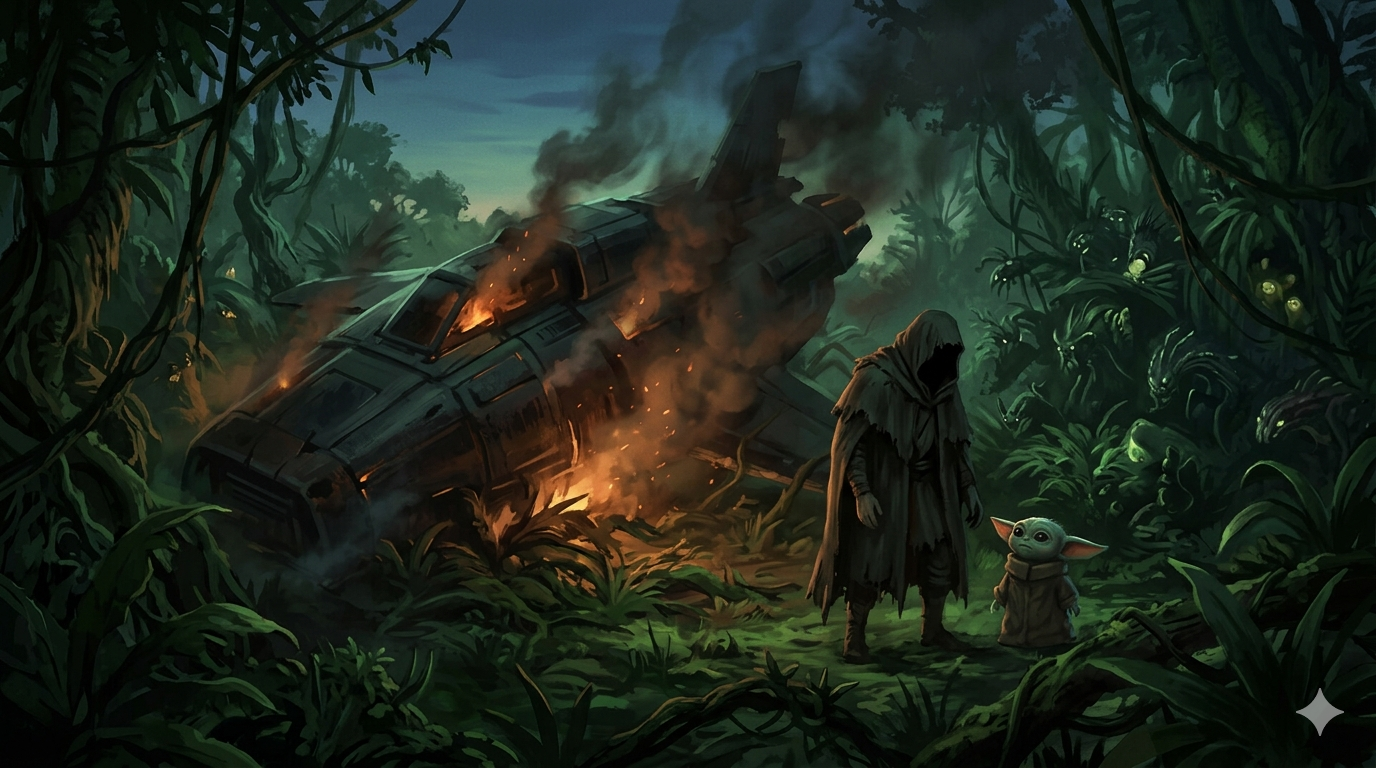
The ship came down hard. It tore through the canopy like a falling star and landed in a tangle of roots, smoke, and twisted metal somewhere deep in a jungle that had no name on any map. Two figures crawled out of the wreckage and stood blinking at each other in the green, dripping silence. One was tall, hunched, and draped in a dark cloak that had seen far better decades. The other was very small, very young-looking, and had ears so large they caught every rustle in the undergrowth. Somewhere not very far away, something with too many teeth made a sound that neither of them wanted to hear again. This is where the lesson about unethical behavior in organisations began. In a jungle. With no escape route. And with two very different ideas about what it means to do good.
The Shadow That Walked Before He Did
Before we go further, you should know what Dar Kaptein had done.
Not all of it. The full list would take longer than the jungle night, and the jungle night was already promising to be very long indeed. But enough. Enough to understand the weight that bent his spine into its permanent curve and made his eyes sit so deep in his face that they seemed to be hiding.
He had run the Bureau of Resource Coordination for eleven years. It had sounded respectable. It had been the opposite. Under his direction, the Bureau had redirected emergency supplies away from crisis zones and sold them at a profit to private contractors. He had falsified impact reports that fed money into projects that did not exist. He had silenced three investigators who had come uncomfortably close to the truth, not with violence, but with something colder: manufactured evidence, ruined reputations, and the quiet weaponising of institutional trust.
He had done all of this while giving speeches about integrity.
He had received awards for transparency.
He had, on one occasion, been asked to keynote a conference on ethical leadership, and he had done so with considerable confidence.
Before the Bureau, there had been the Syndicate of Aligned Futures, where he had overseen a network of aid corridors that existed mainly on paper. Before that, a youth development programme on the outer moons whose funds had been quietly drained over four years while the reports showed record results. He had been, for a very long time, exceptionally good at looking good. He had understood, earlier than most, that the appearance of virtue was more powerful than virtue itself. That a strong enough halo could make almost anything invisible.
The hunchback had come later. Some said it was the weight of the things he carried. Dar Kaptein himself never commented on it. He simply walked with it, bent forward like a question mark the universe had drawn over his whole life.
And then, somewhere between the wreckage of his last operation and the wreckage of this particular ship, something had cracked open inside him. Not dramatically. Not with thunder or revelation. Just a slow, spreading tiredness with himself that had finally become impossible to ignore.
He wanted out. He wanted to build something real. Something that actually helped people.
The question was whether he had any idea how to do that without repeating every mistake that had made him who he was.
The Confession Nobody Asked For
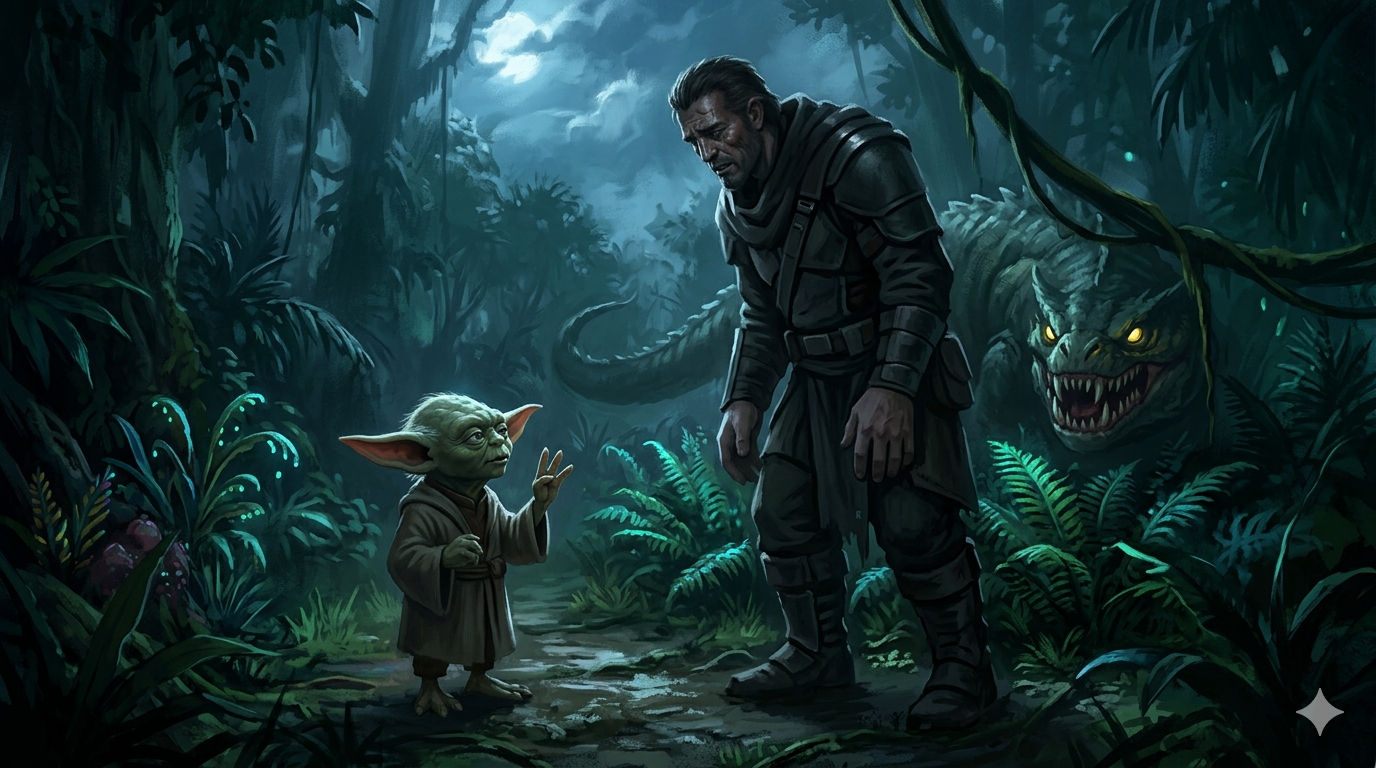
Dar Kaptein straightened his hunchback as much as it would allow, which was not very much, and cleared his throat with the gravity of someone about to deliver a speech they had been rehearsing for years.
"De Yordoso," he said, in a voice like gravel rolling down a staircase, "I have done many terrible things."
De Yordoso looked up at him with wide, glassy eyes. "How many is many?"
"Enough," said Dar Kaptein. He waved a long, bony hand at the smouldering ship behind them. "I want to change. I want to build something good. A real organisation. One with a mission. We would set up food distribution networks on the outer planets where the supply chains have collapsed. We would train local communities to manage their own resources. We would send medical units into the zones that the big institutions have abandoned."
De Yordoso's ears perked up with genuine interest.
"And," Dar Kaptein continued, his voice dropping to something closer to a murmur, "we would build a halo of goodness around it so bright that nobody would ever question us."
De Yordoso tilted his enormous head to one side. A large insect landed on one of his ears and he did not seem to notice. "A halo," he repeated. "Like the ones above the angels in the old paintings?"
"Exactly like that," said Dar Kaptein, and for just a moment, something that might have been hope passed across his craggy face. "When people see a group doing good, they stop asking hard questions. They trust. They donate. They follow. That is the power of the halo effect. We would use it."
De Yordoso blinked. "Use it for good things?"
Dar Kaptein paused just a little too long. "Mostly."
When the Jungle Starts Listening
Something large moved in the ferns to their left. Both of them went very still. The something decided, for now, to move the other way. They breathed again.
"Tell me more about this halo," said De Yordoso, settling onto a mossy root as if they were not currently surrounded by things that wanted to eat them. This was one of his most remarkable qualities. He could be attentive in any situation.
Dar Kaptein began to pace, his cloak dragging through the mud. "When people believe an organisation exists for a noble cause, they project all kinds of virtues onto it. They think the mission is sacred. They think the people inside are saints. They think the rules that apply to other groups do not apply to this one."
"And do they?" asked De Yordoso.
"Do they what?"
"Apply."
Dar Kaptein stopped pacing. This was, he realised, a more complicated question than it sounded. "Well," he said carefully, "that depends on who you ask."
De Yordoso nodded slowly, as though this answer had confirmed something he already suspected. "I think," he said, in his small, mild voice, "that this is exactly where unethical behavior in organisations begins."
The Three Crowns of a Very Dangerous Kingdom
Dar Kaptein turned to look at his small companion with something between irritation and reluctant respect. "You have studied this?" he asked.
"My family has studied many things," said De Yordoso. He was, though nobody looking at him would ever guess it, the last living descendant of one of the oldest and most learned bloodlines in the galaxy. His people had spent generations observing organisations, leaders, and the slow corruption of good intentions. He looked like a child. He thought like a library.
"There are three parts to the halo," De Yordoso continued, holding up three small fingers. "The mission. The morals. And the people."
Dar Kaptein crossed his arms. "Go on."
"When a group glorifies its mission, it starts to believe the cause is above everything. Rules, honesty, other people's safety. The mission becomes a reason to do almost anything. Researchers who studied this found it clearly: mission glorification is one of the strongest drivers of unethical behavior in organisations built to do good."
Another sound came from the jungle. Closer this time. Both of them ignored it with the discipline of beings who had more pressing intellectual matters to settle.
"The second crown," De Yordoso went on, "is morals. When a group believes its own moral standards are higher than the law, it starts to feel it can operate outside the law. This is called moral superiority. It feels noble. It is actually very dangerous."
Dar Kaptein shifted his weight. He recognised that feeling intimately. He had told himself, during the years at the Bureau, that the official rules were too slow, too blind, too built for ordinary situations. His situation had always been the exception. His judgment had always been the one that mattered. He had broken rules he found inconvenient and called it wisdom.
He said nothing. But something in his face moved.
"And the third?" he asked, more quietly now.
"The people," said De Yordoso. "When everyone in a group is seen as an angel, nobody watches anyone. If a problem appears, it is hidden, because it cannot possibly be true. Because good people do not do bad things. Except," he added, with the gentle precision of someone pulling a splinter, "they do. They always can. And without ethics management, there is no way to catch it in time."
What the Dark Side Already Knew
A long silence followed. Something rustled. Something else answered it. The jungle was beginning to narrow its options.
Dar Kaptein sat down on a piece of broken hull plating and looked at his hands. They were large hands. They had signed documents that sent aid to the wrong places. They had pointed in directions that served only him. He had spent two decades wrapping wrongdoing in the language of necessity. He had been the most dangerous kind of corrupt: the kind that believes, on some level, that it is all still somehow justified.
"I wanted to build the halo on purpose," he said at last. "I thought if I surrounded the organisation with the right image, the right words, the right look of goodness, then whatever we did inside it would be protected. The food networks, the medical units, they would be real. But the halo would also be a shield. A way to operate without scrutiny."
De Yordoso looked at him with eyes that were, for just a moment, not young at all. "That is not a new plan," he said. "It is the oldest plan. And the researchers who studied this found something very clear. The organisations with the strongest halos showed the most unethical behavior. Not because evil people joined them. But because good people stopped watching."
Dar Kaptein was quiet for a long time. In the distance, something howled.
"So the halo," he said slowly, "is not a shield. It is a blind spot."
"It is both," said De Yordoso. "That is what makes it so very difficult to manage."
The Moment a Teacher Becomes a Student
"Then what do I do?" Dar Kaptein asked. It was perhaps the first genuinely honest question he had asked in years. It came out smaller than he intended.
De Yordoso stood up from his root, brushed a large beetle off his sleeve, and looked up at the enormous, hunched figure beside him with something that was not pity and not admiration but a combination of the two that has no exact name.
"You told me you wanted to leave the dark side," he said. "And I believe you. But you cannot leave it by building a new organisation around a borrowed halo. You cannot replace old wrongdoing with new self-righteousness. When a group believes it is too good to fail, it creates the exact conditions where unethical behavior grows fastest."
"Then how," said Dar Kaptein, and his voice had lost its gravel and found something rawer underneath, "does a person actually change?"
"Slowly," said De Yordoso. "And with a great deal of critical self-reflection. You start by admitting the organisation is not perfect. You build systems for people to speak up. You reward honesty over results. You make ethics a real conversation, not a poster on a wall. You do not hire angels. You hire people, and then you build structures that help people choose well, even when it is hard."
A very large shape emerged from the ferns about twenty meters away. It had luminous yellow eyes and expressed a strong opinion about their presence by showing all of its teeth.
Neither of them moved.
"That," said De Yordoso, in the same calm tone he had used throughout, "is a secondary problem. The ethics management question is the primary one."
Dar Kaptein stared at the creature. Then he looked down at De Yordoso. "You are not what I expected," he said.
"No," agreed De Yordoso. "I rarely am."
The creature, perhaps sensing that neither of these two was worth the effort, retreated back into the ferns. They both let out a long, slow breath at exactly the same moment. And then, for the first time since the ship had come down, they both started to laugh. It was not elegant laughter. It was the kind that comes from pure relief and the sudden absurdity of being alive, and it echoed up through the canopy and startled a flock of luminous birds into the darkening sky.
Dar Kaptein looked down at the small creature beside him, still catching his breath, and felt something he had not felt in a very long time. Not the cold satisfaction of a plan working. Something warmer and considerably less familiar.
"Thank you," he said. "I think you may be the first honest person I have spoken to in twenty years."
De Yordoso looked up at him. "You are welcome," he said. "And for what it is worth, I think you are considerably less terrible than you believe yourself to be. Which is a reasonable place to start."
What Grew Back After the Halo Fell
They spent the night beside the wreckage, back to back against the cold, taking turns keeping watch. By the time the first grey light came through the canopy, something had settled between them with the quiet permanence of things that do not need to be named to be real.
Dar Kaptein did not build the organisation he had imagined at the crash site. He did not build a gleaming structure wrapped in the borrowed light of a manufactured halo. Instead, with De Yordoso beside him as something that had become, against all odds, a genuine friend and the sharpest conscience he had ever known, he began something smaller and harder and far more real.
The food networks came first. Small, honestly run, with local people in charge and real reporting structures in place. The medical units followed. Then the training programmes for community resource management on the outer planets. Every part of it built on the same foundation: no mission was sacred enough to excuse dishonesty, no person was angelic enough to go unwatched, and no halo was worth more than a culture where someone could stand up and say something is wrong here without fearing what came next.
It was not dramatic work. There was no thunderclap of redemption. There was just the quiet, daily discipline of ethics management, applied honestly, one decision at a time. And there was De Yordoso, always nearby, asking the questions that needed asking in that small mild voice that had a way of reaching the places louder voices never could. He had come looking for a student. He had found something rarer: a person willing to be changed by the truth.
Dar Kaptein still walked with a hunch. But he walked forward now, which made all the difference.
And somewhere in the wreckage of the old ship, a long dark cloak was left behind, snagged on a branch, slowly becoming part of the undergrowth.
He did not go back for it.
He had better things to carry.
*
This article is based on the scientific paper:
De Bruin Cardoso, I., Meyer, M., & Kaptein, M. (2025). Exploring the dark side of the NGO halo: Relating NGO mission, morals, and people to NGO unethical behavior. Journal of Philanthropy. https://onlinelibrary.wiley.com/doi/10.1002/nvsm.70000