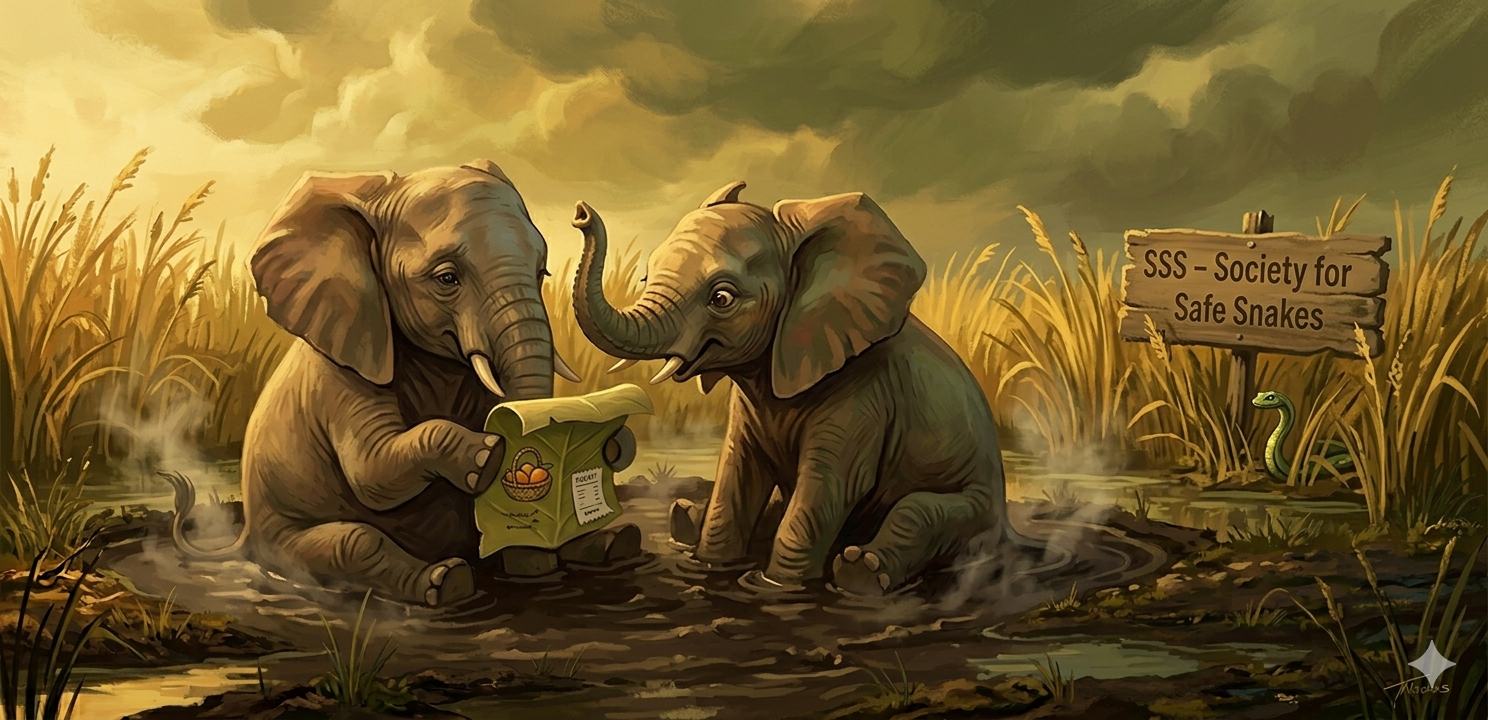
The summer mud at the edge of the swamp was exactly the right kind of warm. Thick, dark, and smelling of earth and old rain, it hugged you in all the right places if you were an elephant teenager with nowhere important to be. Tumba had settled in up to her elbows, eyes half-closed, ears fanned out like two lazy sails, when she remembered what she had read that morning. Her ears folded shut.
"I found out something," she said. She did not sound like someone announcing good news.
Clanna, who was turning slow circles nearby to coat her back evenly, did not look up. "You always find something. You are always sad about it."
"The Society for Safe Snakes used my donation money to send their CEO on a jungle vacation."
Clanna stopped turning.
"It was in the watering hole newsletter," Tumba said. "Someone posted the financial records. There was a receipt. For mango baskets. Decorative ones." She said the last two words the way you say words that you cannot quite believe exist in the same sentence as the thing that made you angry. "Not cutting the grass next to the swamp. Not marking the paths. Not protecting the snakes from being stepped on. Decorative mango baskets."
Clanna pulled herself up out of the mud. Now she was interested.
The First Crack
Tumba had given to the Society for Safe Snakes, known all across the savanna as the SSS, because she believed in what they promised. She was the kind of elephant who winced when she heard the crunch underfoot. She could not stand the idea that a creature could die simply because it happened to be small and in the wrong place at the wrong time. She had trusted the SSS because they existed for exactly that reason. Their mission, printed on the leaves they distributed at every gathering, was to clear the grass, mark the paths, protect the snakes. They were supposed to be, in the most simple and complete sense, good.
That is the thing about charities. When you give to one, you are not buying a product. You are handing a piece of your belief to something larger than yourself. You are saying: I trust you with this. Do good with it. The relationship is built entirely on faith, and faith can carry enormous weight until the moment it cannot carry any at all.
Researchers who study how donors respond to charity scandals have found something that will not surprise Tumba: the hurt that comes from a betrayed charity is sharper, and stranger, than the disappointment that comes from a betrayed business. When a company does something wrong, we get angry. When a charity does something wrong, we get suspicious. We start to wonder where all the money really went. We start to ask whether any of it ever helped anyone. The wound is not just about the wrong thing that happened. It is about every good thing we thought was happening, and now are not sure of.
"How much of it?" Clanna asked.
"Enough for a two-week stay," Tumba said. "Plus the baskets."
When You Need a Friend
Clanna was quiet for exactly as long as it took her to decide how she wanted to enter this situation. Then she entered it with enthusiasm.
"I told you," she said, which was technically a lie, since she had never expressed any prior opinion about the SSS. "This is what always happens. You give your money away to strangers and strangers spend it on decorative fruit arrangements. That is the natural order."
"That is not a natural order," Tumba said. "That is a specific misuse of funds."
"Also," Clanna continued, picking up speed, "stepping on snakes is what has always happened. Dawn of time. Elephants walk, snakes get stepped on. It is not our job to manage the grass."
"It is not our job to step on small living things unnecessarily," Tumba said quietly, and there was something so flat and tired in her voice that even Clanna paused.
But Tumba also stayed silent for a long moment after that. Because Clanna's words, even when wrong, had landed somewhere uncomfortable. Maybe the donation had been foolish. Maybe the whole SSS had always been like this and she had simply not looked closely enough.
"I do not know what to conclude," she said finally.
She meant it. And that honesty, the refusal to jump either to rage or to easy forgiveness, was one of Tumba's better qualities, even if Clanna experienced it as irritating indecision.
Here is what Clanna was doing, even without knowing it: she was using Tumba's disappointment as proof that the whole project of caring was foolish. This is a tempting move. When a charity fails, the failure can feel like evidence against generosity itself. But researchers have found that most donors, when they step back from the initial shock, do not actually reach this conclusion. The snakes still deserved to be safe. The problem was not the mission. The problem was the people who were supposed to carry it out.
The One Who Arrived Through the Reeds
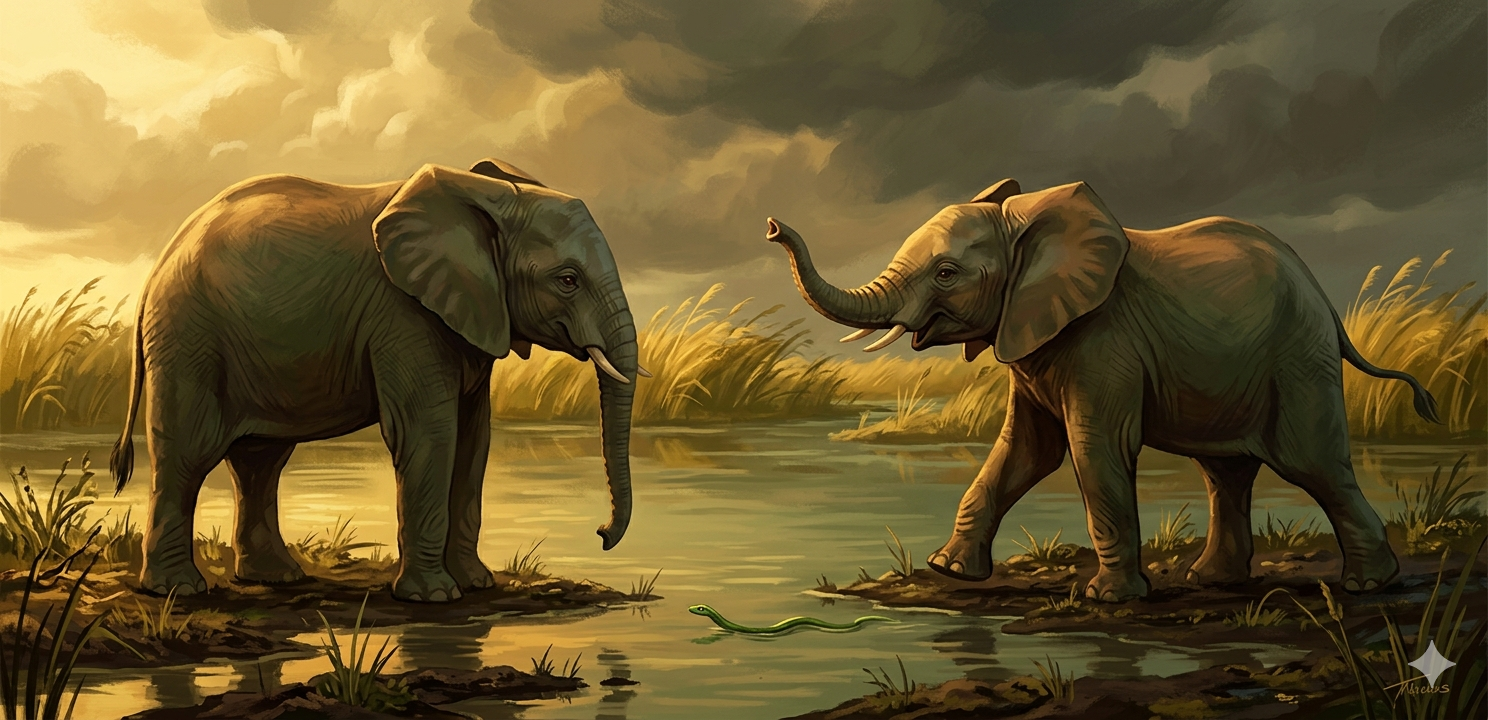
There was a soft rustling near the edge of the tall grass. Neither Tumba nor Clanna noticed it at first. Then it came again, more deliberate, and they both looked down.
A small snake was making its way along the bank, moving with the unhurried purpose of someone who lives close to the ground and has learned that most crises look different from down there. This was Sympy. Sympy knew Tumba well enough, and had heard enough of the conversation while crossing the mud flat to know what it was about.
Sympy stopped, raised the front of a body slightly to be seen, and spoke.
"I have news about your snake situation."
"It is not my snake situation," Tumba said, automatically.
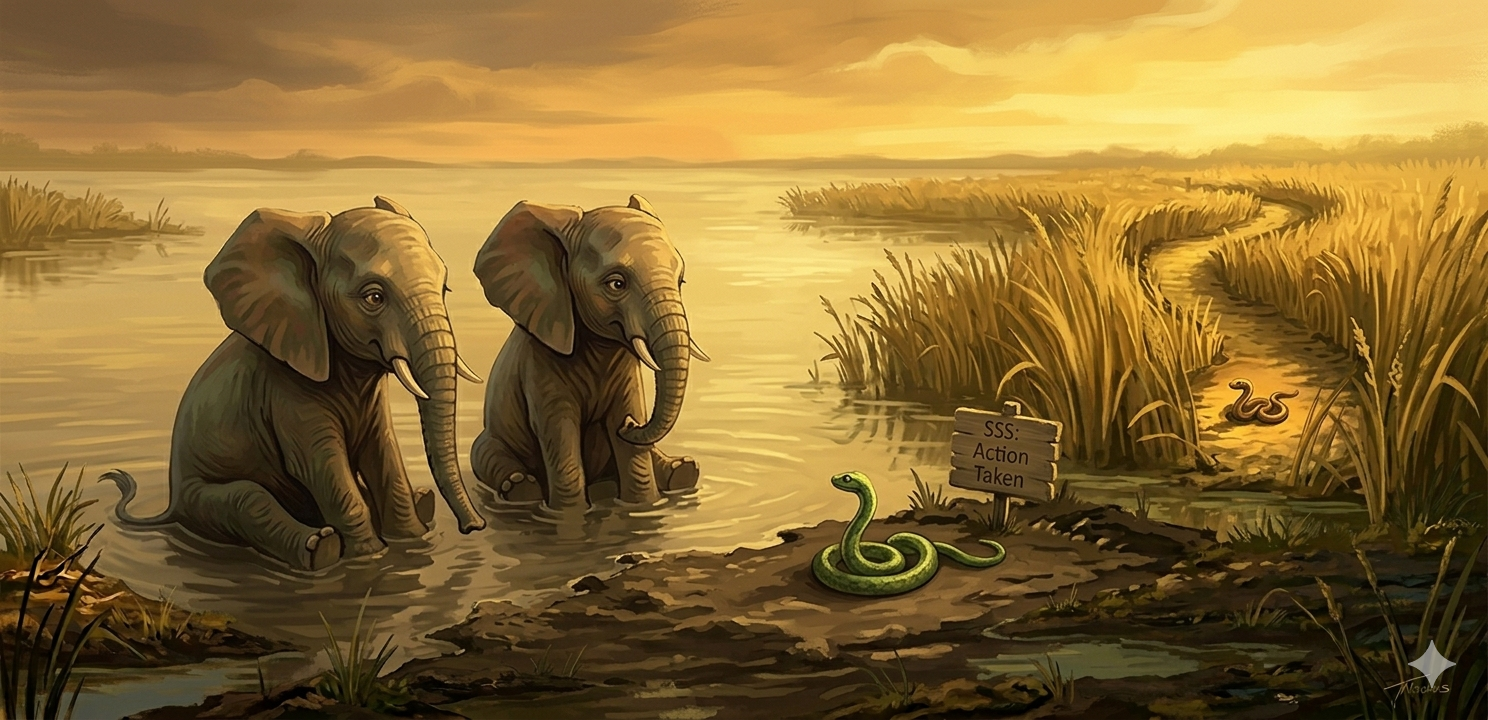
"The SSS Board met this morning," Sympy said. "They found out about the vacation. And the baskets. They fired the Fundraising Manager. Apparently she was the one who approved the expenses and moved the budget without authorization. The Board released a full statement. They are publishing the complete financial records. They promised a review of every donation and how it gets used. They are asking donors to continue supporting the grass-cutting program while they stabilize."
Silence settled over the swamp the way silence does when information arrives that changes the shape of a conversation.
"They fired her," Tumba said slowly.
"Within the week of finding out," Sympy confirmed, and then continued along the bank, because snakes have places to be too.
Same Truth, Two Angles
What happened next between Tumba and Clanna was not an argument, exactly. It was more like watching two different maps of the same territory appear side by side.
Clanna's map said: a charity did something wrong, which proves all charities are likely to do wrong things, which proves that the instinct to donate is naive, and the correct response is to withdraw permanently and feel satisfied about having done so. She had already decided she would look into other snake protection groups, ones with, in her words, less drama. Whether she would actually donate to any of them was a question she had not gotten to yet.
Tumba's map said something harder to draw. A person inside a charity did something wrong. The charity found out. The charity acted. The cause, the snakes in the grass, the paths uncleared, the small creatures still at risk, had not changed. The question now was not whether to care. The question was whether this organization could still be trusted to carry that care responsibly, and what it would take to find out.
Researchers who have spent time studying exactly this kind of moment have found that most donors instinctively make the distinction Tumba was working toward. They separate the individual who did wrong from the organization that employed them. They are often willing to hold the individual to a very high standard of accountability, while still protecting the organization's ability to continue its work. They understand, somewhere beneath the anger, that collapsing the two things together, deciding the whole enterprise is worthless because one person was dishonest, does not actually help the snakes.
The individual who misused the funds is a different matter entirely. In study after study, donors proved far less forgiving of the specific person responsible than of the organization that was damaged by them. Accountability for individuals and grace for institutions, it turns out, can exist at the same time. They do not cancel each other out.
"I am not ready to give to them again," Tumba said carefully. "Not yet. But I am not ready to say I never will. I want to see the financial review. I want to see what actually gets fixed."
"You want to be proven right," Clanna said, not unkindly.
"I want them to earn it," Tumba said. "Which is different."
Clanna thought about this for a moment longer than she usually thought about things Tumba said.
The Science of Forgiveness
Here is what research tells us, plainly.
When a charity betrays your trust, the initial wave of feeling tends to be suspicion, not rage. You start asking where the money went. You wonder what else might have happened that you do not know about. This suspicion is more chilling, in some ways, than the hot anger you might feel toward a dishonest company, because the relationship with a charity is built on something the relationship with a company is not: the belief that they are genuinely trying to do good in the world.
That same belief is also what makes forgiveness more possible, eventually, than it would be for a company. When researchers spoke with real donors about charity scandals, most of them were willing to return, under the right conditions. Those conditions were clear: the charity acknowledges what happened, it fixes what went wrong, and it continues helping the people who depended on it. Forgiveness, in this picture, is not about letting the charity off the hook. It is about making sure the mission survives the people who failed it.
There is also a harder finding. When charities are not forgiven, most donors do not simply give up on helping. They switch to a different charity doing the same work. They find another organization clearing the same paths, protecting the same small creatures. The instinct to help does not die when one organization disappoints them. It redirects. And there is something quietly hopeful in that.
Charity trust, it turns out, is not the same thing as charity blindness. Knowing who deserves forgiveness, who deserves accountability, and how to keep giving wisely after a nonprofit scandal, may be the most important thing a donor can learn.
Warm Mud
The conversation wound down the way swamp conversations do, sideways and without a conclusion everyone could agree on. Clanna announced she was going to look into other snake protection groups. Tumba said she was going to wait for the SSS financial review before she decided anything. Neither of them was wrong, exactly.
Somewhere nearby, just past the tall grass where Sympy had disappeared back into the undergrowth, a path through the reeds had been cleared recently. The SSS had done that, before everything. The snakes who lived there did not know any of this had happened. They did not know that someone had tried to protect them, that someone had stolen from that effort, that someone had been fired for it, that two elephants were sitting in mud arguing about whether good things could survive bad people.
Tumba thought they probably could. She thought it was worth finding out.
She did not say this to Clanna. But she did not let go of it either.
*
This article is based on the scientific paper: Ren, C., Moisieiev, D., Rodrigo, P., & Johnson, E. (2024). Hot and cold: How do consumers hate and forgive offending charity brands? Journal of Philanthropy and Marketing, 29(3), e1875. https://doi.org/10.1002/nvsm.1875