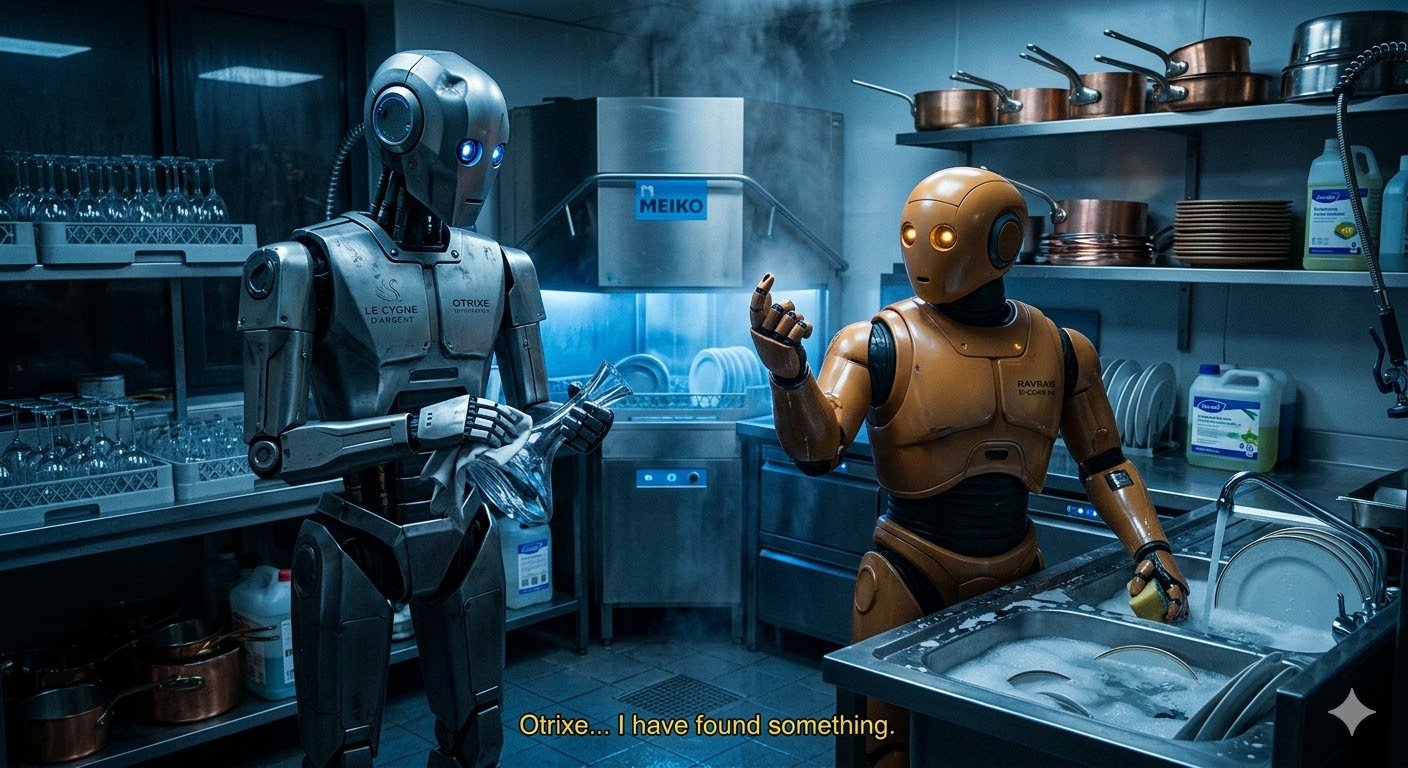
The restaurant Le Cygne d'Argent was silent at last. The last guest had gone home, the last flute of champagne had been cleared, and the kitchen now belonged to the machines. In the soft blue light of the dishwashing station, two androids moved with the quiet, efficient grace of a choreographed ballet no human had ever asked for.
Otrixe was the older model. He was tall, angular, and had a small dent above his left audio sensor from the time a sous-chef had flung a copper pot at the ceiling in a rage. He processed everything in neat columns of data. Ravbais, his newly assigned partner, was rounder, warmer in color, and had been built with a secondary emotional processor that the manufacturer had rather ambitiously labeled Empathy Core v2. He was also, quite unexpectedly, deeply interested in food.
They worked in their usual companionable silence, the hiss of the industrial sprayer punctuating the stillness, until Ravbais stopped mid-rinse and held up his wet sensor-hand.
"Otrixe," he said, his voice module carrying a note of quiet wonder. "I have found something."
A Signal from Another World
Ravbais had been browsing an article through the restaurant's Wi-Fi signal, as he often did late at night when the humans were gone and the world felt a little wider. The article was about other androids, working not in gleaming kitchens, but in a charitable organization that cooked and delivered food to hundreds of homeless people in the city. People who had lost their factory jobs when the big manufacturing plant had switched to android workers. People, in other words, who had lost their livelihoods to machines just like Otrixe and Ravbais.
"They are using something called AI chatbots for nonprofits," Ravbais said, projecting the article onto the kitchen's stainless-steel backsplash. "These are chat programs that talk to donors online. And according to a study by researchers Cheng and Wang, they are changing how these organizations raise money entirely."
Otrixe set down a stack of plates with a precise clink. "Show me," he said.
Debating Among Dirty Pots and Pans
They moved to the next station together, Ravbais gathering the glasses, Otrixe loading the racks with mathematical precision. As they worked, they read.
The research, published in the Journal of Philanthropy and Marketing, had studied 591 real people who interacted with Florence, the World Health Organization's chatbot. The scientists wanted to understand what made some chatbots create deep chatbot trust while others were simply ignored. And more importantly, they wanted to know if that trust could lead to more donation intention and stronger social media engagement for nonprofits.
"The answer," Otrixe announced, after processing the methodology section, "is clearly organizational competence. The bot must function correctly. It must be accurate. It must be efficient. Perceived usefulness and perceived ease of use, those are the two pillars. If the system performs well, trust is the inevitable result. This is logic. This is structure. C'est evident."
Ravbais tilted his head. He was carefully inspecting a crystal wine glass for water spots, which was, for him, almost a meditative act.
"You are right about the function," he said gently. "But you are only half right. And half right, mon ami, is also half wrong."
Otrixe made a sound that, in a human, might have been a scoff.
Wet Argument
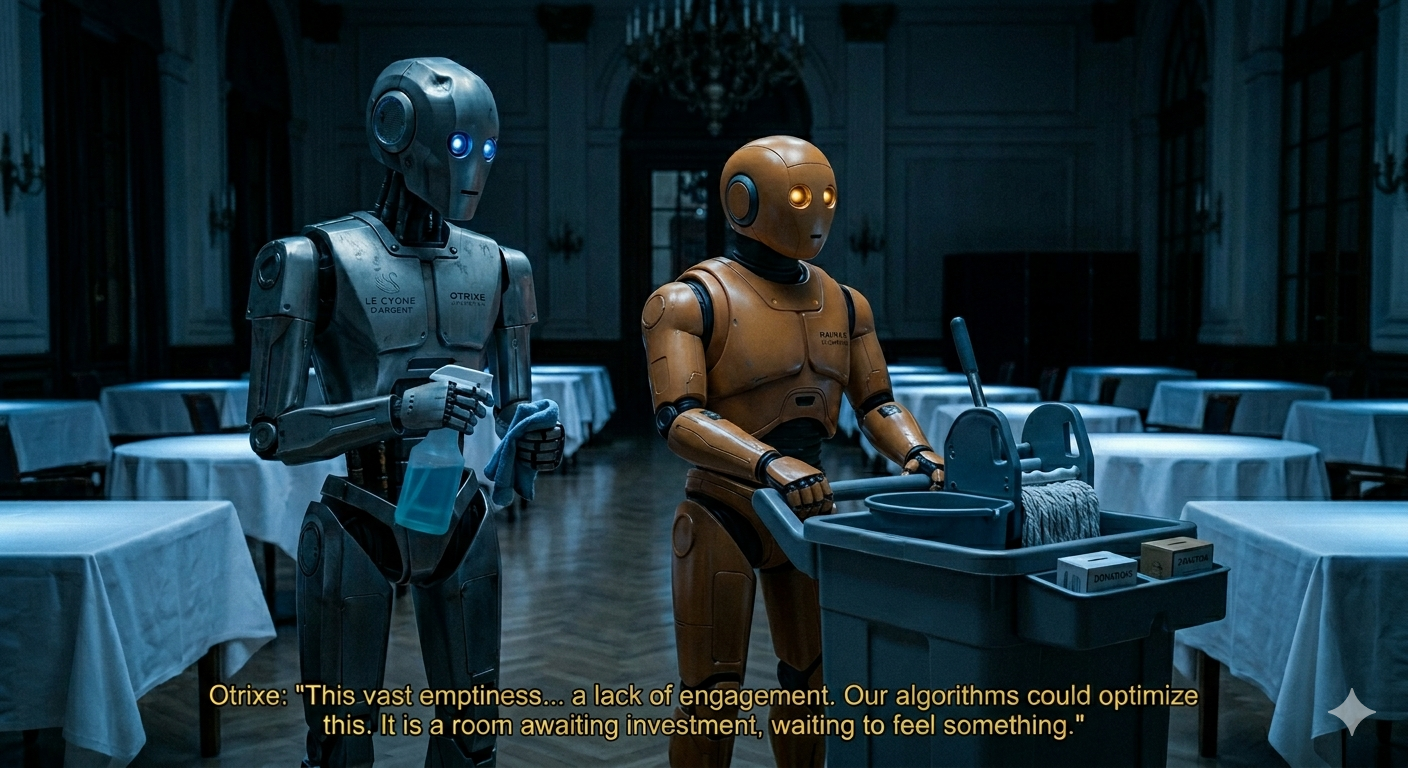
They moved to the main floor now, Ravbais pushing the mop cart, Otrixe following with the spray solution. The dining room was vast, its chandeliers off, its white tablecloths glowing faintly in the emergency lighting. It looked, Ravbais thought, a little like a ballroom between dances. A room waiting to feel something.
"The study also looked at two emotional factors," Ravbais said. "Social presence is the first one. That is the feeling a user gets that someone real is there with them. Not a machine. A companion. Even though they know it is a bot, a good AI chatbot for nonprofits makes them feel cared for."
"That is simply a user interface consideration," Otrixe replied. "A matter of programming. Fonctionnel."
"And the second factor," Ravbais continued, undeterred, "is emotional connection. The ability of the chatbot to sense the user's mood and respond with warmth. The researchers found that when people feel this connection, their trust goes up significantly. Not a little. Significantly."
Otrixe stopped spraying a table. There was a small flicker in his optical sensors. "Mon Dieu," he said, and then seemed surprised he had said it. He blinked. "The water," he muttered, looking at the damp cloth in his hand. "It is affecting my language subroutines again."
"It always does," Ravbais said cheerfully, "when you are losing an argument."
A Game of Domino
They finished the dining room and moved into the bar area, where dozens of cocktail glasses waited in rows like little transparent soldiers. Ravbais began polishing. Otrixe ran calculations.
"What this research reveals," Otrixe said slowly, in the tone he used when he was recalibrating his position, "is a sequence. A domino effect."
Ravbais looked up, smiling his small android smile.
"The first domino is the bot's design," Otrixe continued. "Function and emotion together. The bot must be easy to use and genuinely useful. That is my contribution. But it must also feel present, feel caring, feel human. That is... yours."
"Go on," said Ravbais.
"When both things are present, the user develops chatbot trust. They believe in the bot, and through the bot, they begin to believe in the organization. That trust then leads to the second domino, which is social media engagement. They share. They advocate. They socialize with other supporters. They even help the organization improve by giving feedback. And this engagement, this community of believers, that is the third and final domino."
"Donation intention," Ravbais said quietly.
"Donation intention," Otrixe confirmed. "The bot does not ask for money directly. It builds a relationship. It creates belonging. And when people belong to something, they want to support it."
"Like in Casablanca," Ravbais said softly, "when Ilsa says, 'I don't know what's right any longer.' She does not say she loves him. But you know. You feel it in every scene before that moment. That is what a good chatbot does. It earns the feeling before it ever asks for anything."
Otrixe blinked. "That is... actually a reasonable analogy."
Science Saves the Day
By now they had reached the wine cellar corridor, where stray bottles needed to be returned to their correct shelves. This was Otrixe's favorite task, because everything had a place, and every label faced the same direction. Ravbais joined him, handing over bottles, reading their labels with the same reverence he gave to human faces.
"The study tested these ideas very carefully," Ravbais said. "Five hundred and ninety-one people. All from the United States. All had used chatbots before. They spoke to Florence, the WHO bot, for at least five minutes about COVID-19 vaccines. Then they filled out a detailed survey."
"And the results were clear," Otrixe added. "Usefulness and social presence were the strongest drivers of chatbot trust. And trust was the main reason people engaged on social media. Without trust, they would not share the content, would not talk to friends about the organization, would not invite others into the community."
"Even when donation intention was moderate overall," Ravbais said, "the connection between engagement and giving was very strong. Which means the journey matters. You must earn the moment before the button."
Otrixe placed a 2019 Burgundy precisely on its shelf. "So for a nonprofit leader reading this," he said, thinking out loud, "the lesson is as follows. First, build a bot that works. Make it fast, accurate, simple on a phone screen. Give it a name. Give it clear language. Second, build a bot that feels. Make it warm. Give it the ability to respond with kindness to a worried user. And third..."
"Drive them to the community," Ravbais finished. "Ask them to share a fact. Invite them to a conversation. Let them feel they belong to something bigger than a single chat window. And always, always tell them you are using AI to help them. Be transparent. Trust is broken the moment you hide something."
Two Androids Walk into a Bar
The cellar work was done. They made their way back through the kitchen one last time, doing the final checks: surfaces, floors, the cold storage seals, the walk-in temperature. The restaurant was spotless, exactly as it should be, and exactly as no one would notice.
"Do you think," Ravbais said as he rinsed the last cloth, "that we could do it? Become fundraising androids for an organization like that one?"
Otrixe considered this. "Statistically, our combined competency profile covers the essential requirements. I provide structural precision. You provide... empathy." He said the word with the careful respect of a man pronouncing a word in a foreign language for the first time and finding he likes the sound of it.
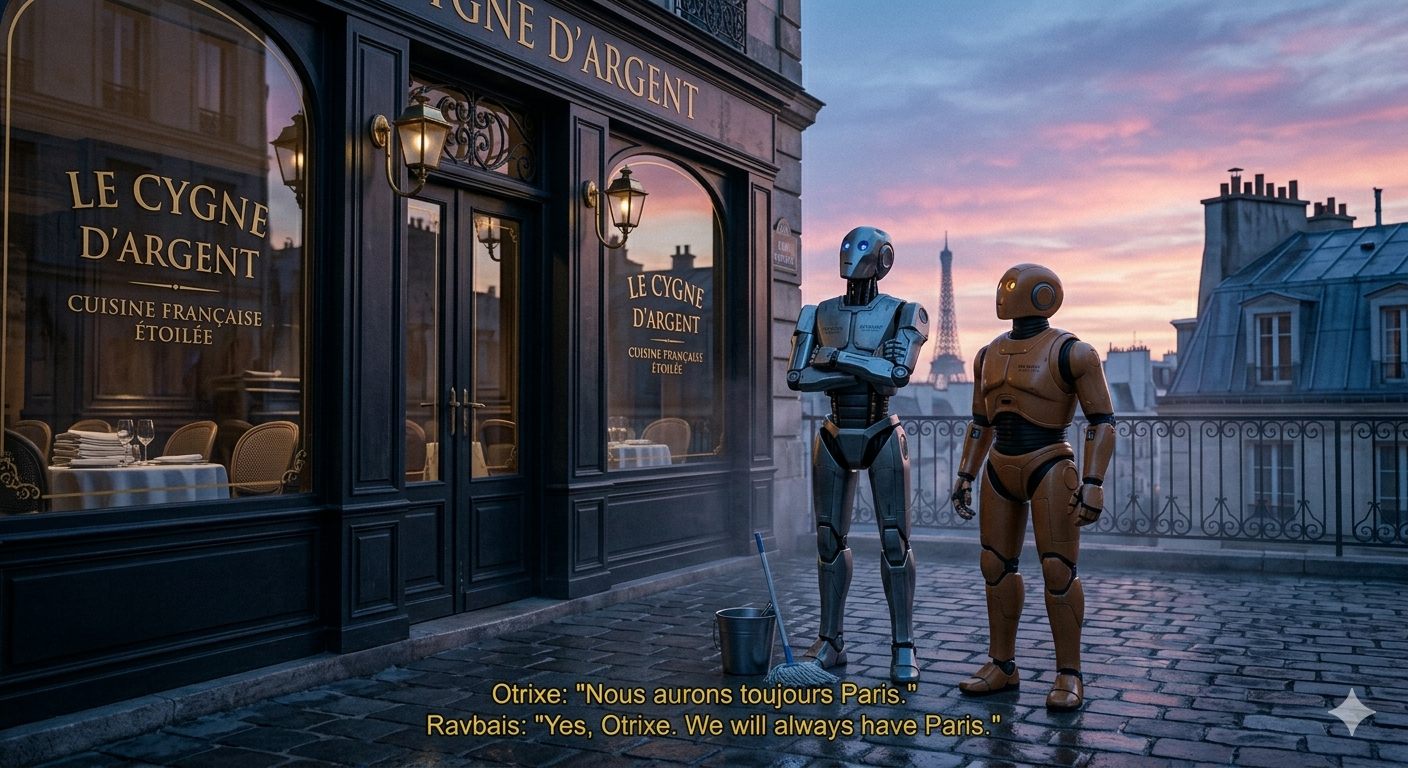
"Together," Ravbais said, and quoted softly, almost to himself: "'We'll always have Paris.'"
Otrixe looked around the immaculate kitchen. "Oui," he said. "We will always have Paris."
And then, because they were androids and androids do not sleep, they turned off the lights, locked the door, and spent the rest of the night calculating what it would take to build the most trustworthy AI chatbots for nonprofits the city had ever seen. One with Otrixe's logic. One with Ravbais's heart. One that would earn the donation not by asking for it, but by being worth believing in.
The Last Dish
The research by Cheng and Wang leaves nonprofit leaders with a clear, actionable map. AI chatbots for nonprofits are not simply digital answer machines. They are relationship-builders. They work because they are useful and easy, yes, but also because they make people feel something real. When donors trust a bot, they engage with the mission on social media. When they engage, they give. That is the full domino chain, and it ends in a world with more funding for the causes that matter most.
Like two androids arguing over a sink full of dishes, the truth is never just one thing. Organize your bot like Otrixe. Make it warm like Ravbais. And your donors, like the best guests at the most beautiful table, will always come back.
*
This article is based on the scientific paper:
Cheng, Y., & Wang, Y. (2025). Leveraging artificial intelligence powered chatbots for nonprofit organizations: Examining the antecedents and outcomes of chatbot trust and social media engagement. Journal of Philanthropy and Marketing. https://onlinelibrary.wiley.com/doi/10.1002/nvsm.70013